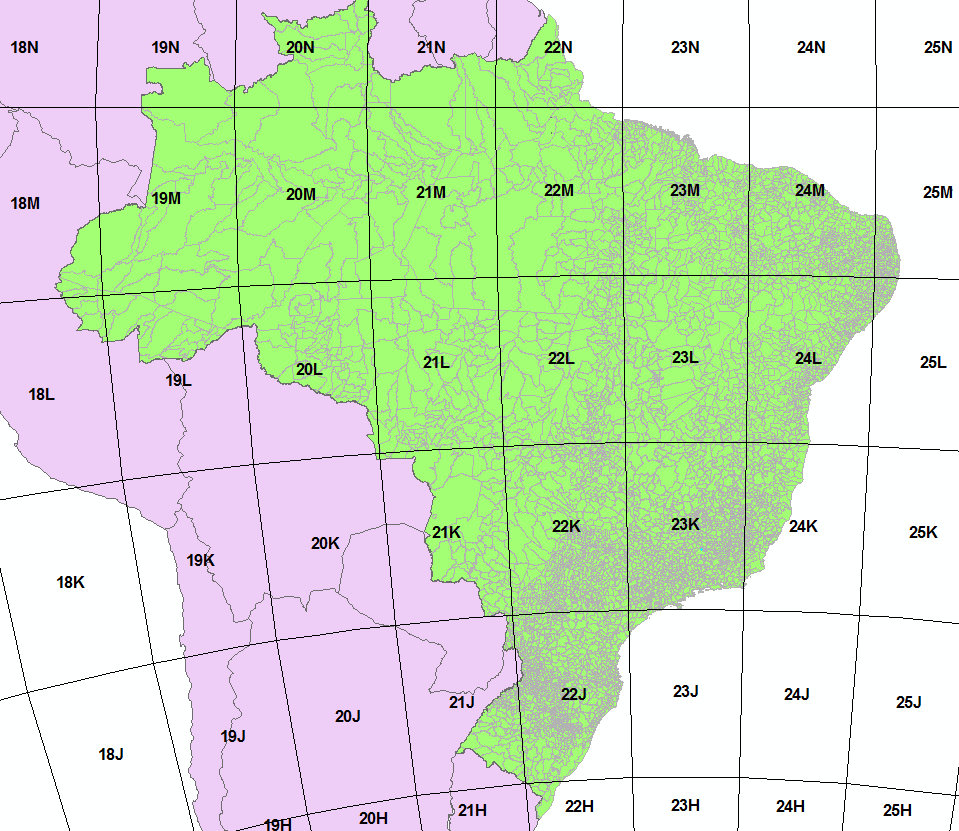
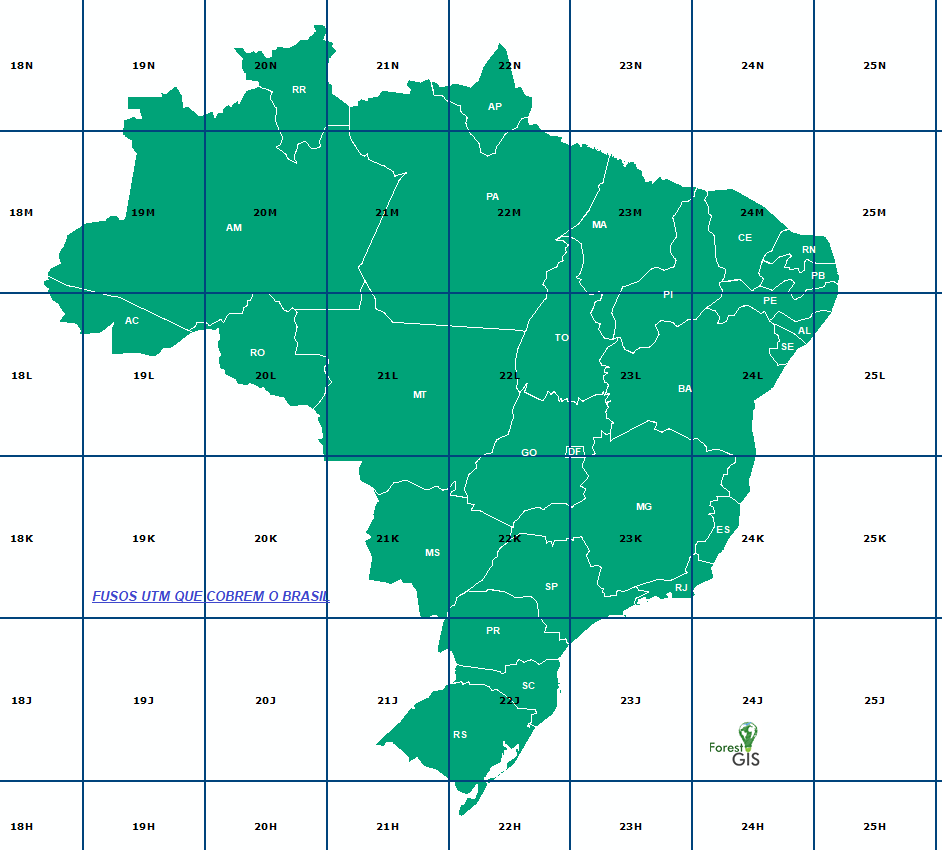
Eight UTM zones cover Brazil, from Zone 18 in Acre to Zone 25 over Fernando de Noronha. Choosing the correct UTM zone is critical for accurate area, distance, and bearing calculations in both local and regional mapping projects.
This page includes coverage guidance, download links, and practical notes for anyone working with UTM projection data in Brazil or other countries using zone-based coordinate systems.
Download the shapefile from this link or download the shapefile here.
Learn how to identify the datum and projection of your spatial data: See how to discover datum and projection.
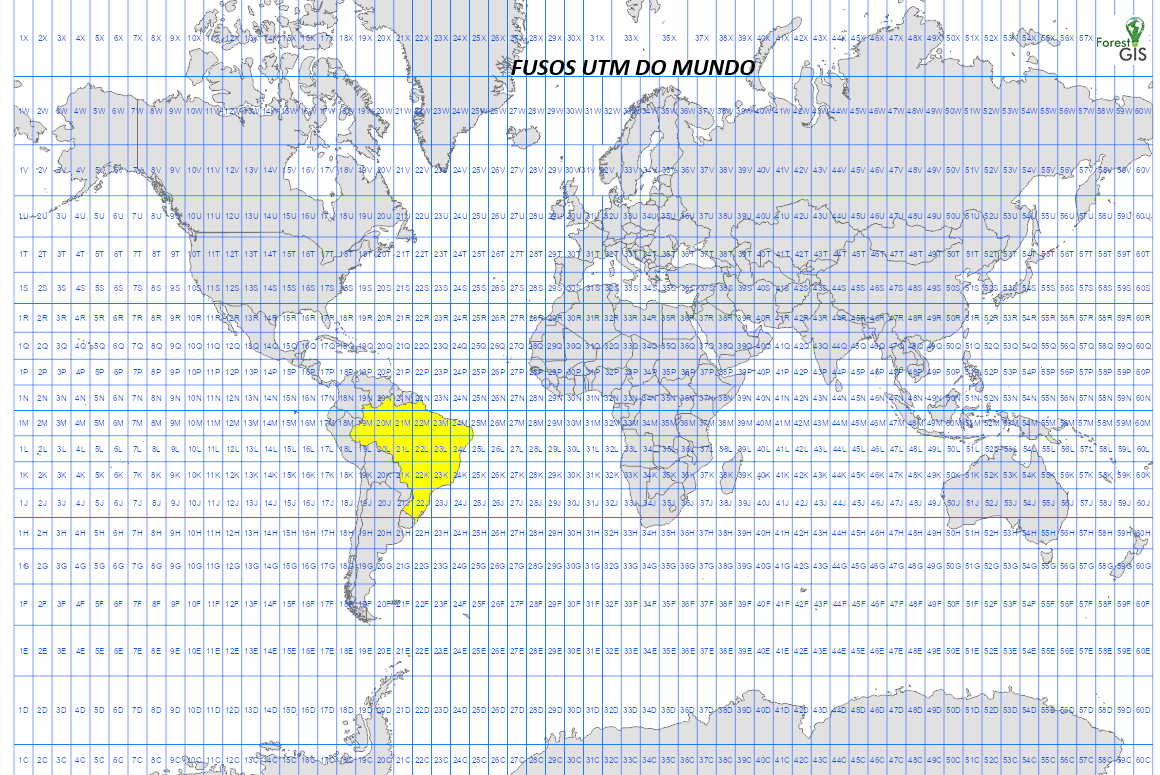
The Universal Transverse Mercator projection divides the world into 60 longitude zones, each 6 degrees wide. It is widely used for local mapping because it preserves scale and direction better within each zone than many global projections.
UTM coordinates are expressed in meters, making them convenient for calculating distances and areas directly in the projected coordinate space. This is why UTM remains a popular choice for forestry, engineering, and cadastral mapping.
UTM is ideal for mapping areas that lie mostly within one zone. If your project crosses multiple zones, use a custom projection or a larger-area projection to avoid distortions at zone boundaries. In the United States, many practitioners also consider State Plane Coordinate Systems for local accuracy, but UTM remains a standard for context where international compatibility is important.
There are 60 zones numbered 1 to 60 from 180°W eastward. Latitude bands from 80°S to 84°N are labeled C through X, excluding I and O. Each zone has a central meridian and uses a false easting so coordinates remain positive.
Always verify the datum associated with your UTM data. In Brazil, common datums include SAD69 and SIRGAS 2000, while in the US, WGS 84 and NAD83 are typical. Using the wrong datum can shift coordinates by hundreds of meters, undermining accuracy for mapping and analysis.
When working with UTM in a GIS, choose a local zone for feature editing and measurement, then reproject to a broader system only when combining datasets from multiple zones or presenting results at a national scale.