You have probably operated a Garmin® GPS or a more precise GPS (topographic, geodetic, RTK, etc.). A well-designed navigation GPS receiver can achieve a horizontal accuracy of 3 meters or better and a vertical accuracy of 5 meters or better 95% of the time. But do you know why the reading is not 100% accurate? Because of GPS error sources:
The sources of GPS errors (or GNSS):
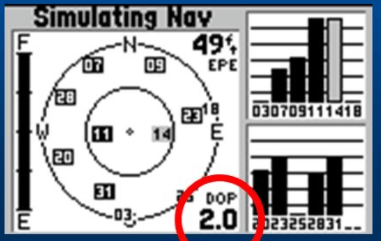
On the device's screen, you have probably observed some readings of variables like HDOP, TDOP, PDOP, etc. If you are not an expert in how the GPS system works, you have probably wondered what those letters and numbers mean.
All variables that end with DOP mean that they are dilutions of precision (DOP=Dilution of Precision). In practice, this error is due to the position of the satellites in the sky. The closer they are to the horizon, the more atmosphere and obstacles the signals face before reaching the receiver. Additionally, the satellites need to be relatively spread out in the sky for better triangulation (technically trilateration) of the signal, a fundamental principle of GNSS systems.
The letter before "DOP" changes the meaning of the variable.
- HDOP: Horizontal Dilution of Precision
- VDOP: Vertical Dilution of Precision
- PDOP: Position Dilution of Precision (3D). Generally, VDOP and HDOP have been replaced by PDOP, which already provides the accuracy of the two previous ones in the same variable.
- TDOP: Temporal Dilution of Precision
- GDOP: Geometric Dilution of Precision. Basically, the combination of all the above. GDOP=SquareRoot(PDOP^2 + TDOP^2)
Regarding the level of DOPs, the following table shows the ranges and levels of accuracy.
| DOP Level | Quality | Description |
| < 1 | Ideal | Highest level of confidence; maximum possible accuracy at all times. |
| 1-2 | Excellent | Accurate measurements |
| 2-5 | Good | Measurements with adequate accuracy |
| 5-10 | Moderate | Moderate quality. Correction recommended |
| 10-20 | Weak | Low level of confidence. Consider discarding data |
| >20 | Poor | Very low accuracy. Errors can reach 300 meters |
Source: Wikipedia

Other sources of errors
In addition to these dilution of precision errors, we also have other types:
Atmospheric refraction:
The troposphere and ionosphere can change the speed of GPS signal propagation. Due to atmospheric conditions, there may be more or less refraction of the satellite signals as they travel to the Earth's surface. To correct this, a GPS can use two separate frequencies to minimize the speed of propagation error. Depending on the conditions, this type of GPS error can add errors of up to 5 meters.
Multipath or Multipath Effect
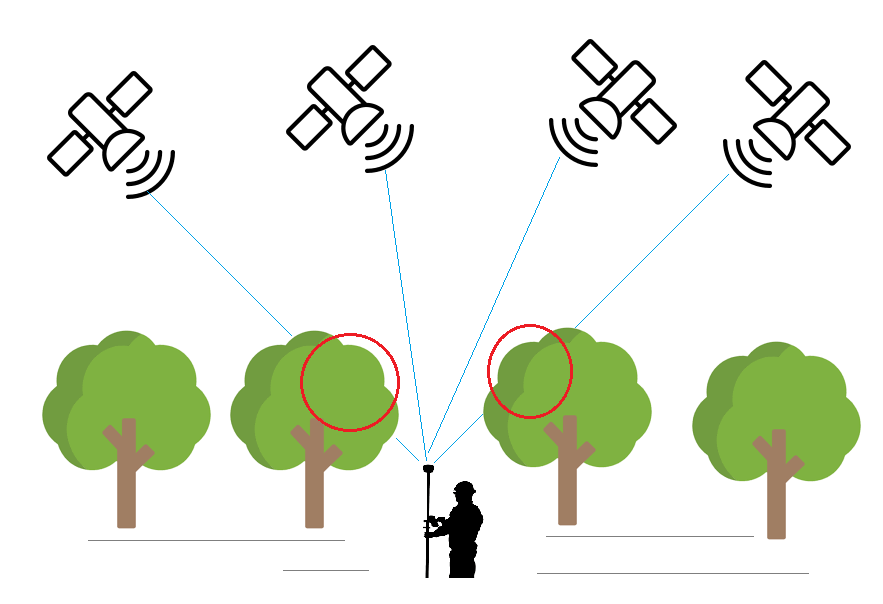
A possible source of error in GPS calculations is the multipath effect. This error occurs when the GPS satellite signal "bounces" off nearby structures, such as buildings, trees, and mountains. As a result, your GPS receiver detects the same signal twice at different intervals. However, this error is somewhat less concerning and can cause positional errors on the order of 1 meter.
Ephemerides
The accuracy of a GPS satellite's atomic clock is one nanosecond. Although impressive, the trilateration of signals in different orbits and the correction of orbital decay introduces positioning errors in the system. Thus, the system operators provide the famous ephemeris information, which contains details about the location of a specific satellite and allows for its correction in post-processing software.
SA (Selective Availability)
Until the year 2000, the U.S. maintained a function that introduced intentional errors into the civilian GPS system. Only American military personnel had access to the error-free signal, logically aiming for a strategic advantage since it would prevent enemies from using the system against the U.S. However, this was deactivated in 2000. Furthermore, the advent of other GNSS systems rendered SA useless.
Obsolescence of DOP
With the introduction of navigators and devices that use more than one satellite constellation (GPS, Glonass, Beidou, Compass, Galileo), GDOP or any of the DOPs is now obsolete and is no longer as important as it once was, since error compensation can be minimized by using satellites from different constellations simultaneously, leading to a DOP generally less than 4 in most locations on the planet (there are still many exceptions, though).
Now, when you observe that variable on your GPS screen, you will know what it refers to!