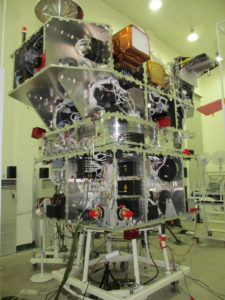
Brazil and China announced this Wednesday (12) the end of operations for the CBERS-2B satellite, which was launched in 2007 and captured thousands of images over both countries as well as other regions in South America and Africa.
Built from remaining parts of CBERS-2, launched in 2003, the satellite had an estimated useful life of two years. It completed around 13,000 orbits and generated roughly 270,000 images for Brazilian users and another 60,000 images for more than 40 countries.
Technicians had been trying to resolve communication failures since March. In mid-April, it was no longer possible to establish contact. At that point, the Chinese Space Technology Agency and the Space Institute for Special Research (INPE), responsible for the CBERS program in Brazil, announced the satellite's end of operations.
With the satellite offline, the image supply for programs such as Prodes and Deter — through which INPE monitors Amazon deforestation — is reduced. According to INPE, monitoring conditions are not ideal without CBERS-2B, but surveillance systems can continue using images from other satellites such as the American Terra/MODIS, Landsat-5, and the Indian ResourceSat.
According to G1, the next satellite in the Sino-Brazilian program was expected to be CBERS-3, scheduled for the second half of 2011, with CBERS-4 planned for 2014.
For U.S. GIS and forestry professionals: this article is localized from Brazilian Portuguese and expanded with practical U.S.-relevant guidance. When legal or technical terms are Brazil-specific, a brief note explains the U.S. equivalent.